DIN 127 Spring Washer
What is a Spring Washer?
Spring washers are critically important industrial components that prevent the loosening of threaded fasteners in environments with vibration and dynamic loads. These specially designed washers, defined by the DIN 127 standard, operate on a spring principle, applying continuous pressure, unlike traditional flat washers.
Working Principle and Technical Advantages
When a spring washer is positioned between a nut or bolt and the connection surface, its open-ended structure provides excellent seating by flexing during tightening. This flexing action applies a continuous axial pressure force to the fasteners, effectively preventing loosening caused by vibration and dynamic loads in the system.
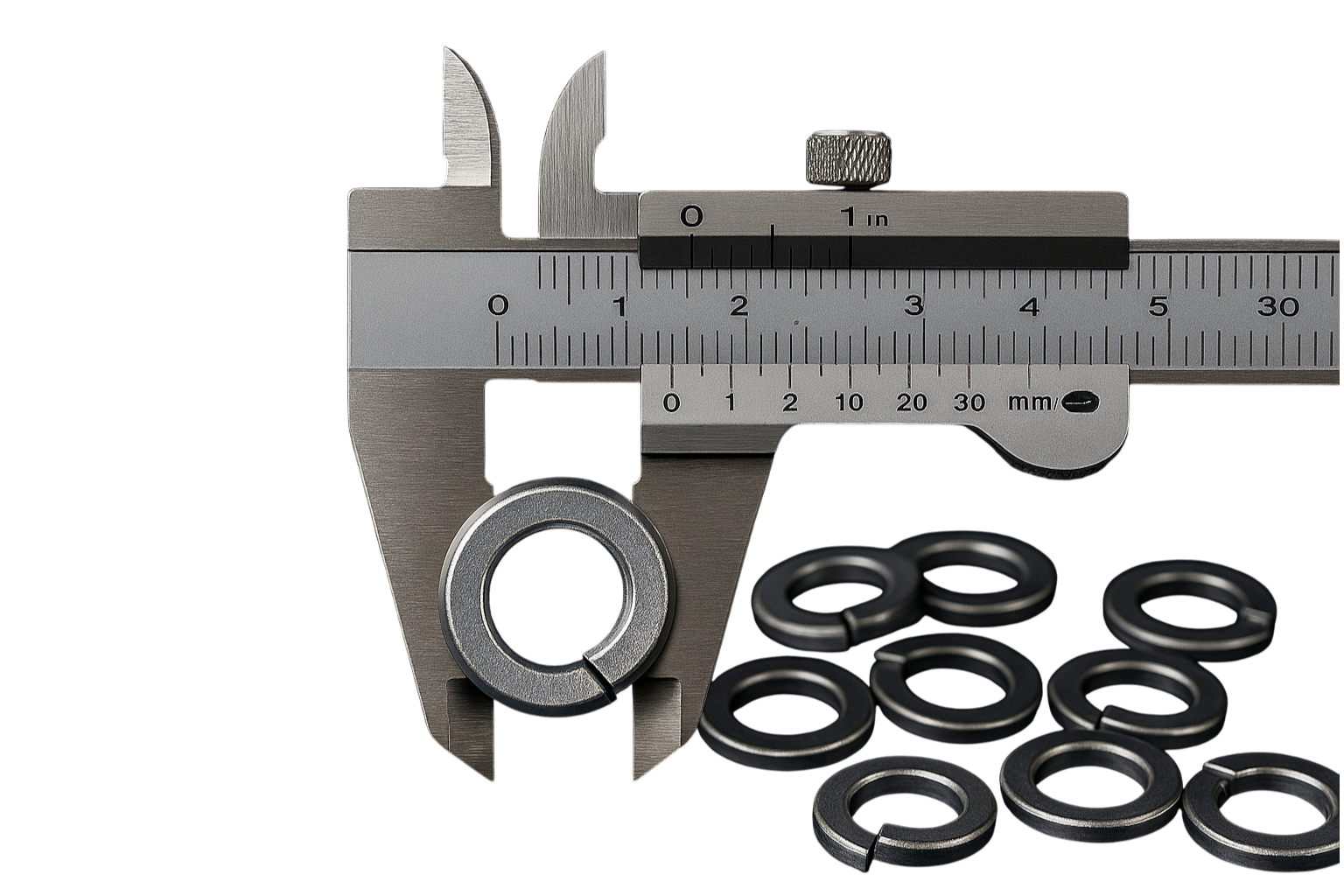
DIN 127 Standard and Features
The DIN 127 standard is an internationally accepted norm established by the German Institute for Standardization that defines the technical specifications, dimensions, and tolerances of spring washers. Washers produced in compliance with this standard offer a guarantee of high quality and reliability.
DIN 127 SPRING WASHER TECHNICAL DATA
| Thread Diameter | D1 MIN | D1 MAX | D2 MAX | H MIN | H MAX | B MIN | B MAX | S MIN | S MAX | GR/P |
|---|---|---|---|---|---|---|---|---|---|---|
| M.3 | 3.1 | 3.4 | 6.2 | 1.6 | 1.9 | 1.3 | 1.4 | 0.7 | 0.9 | 0.11 |
| M.4 | 4.1 | 4.4 | 7.6 | 1.8 | 2.1 | 1.4 | 1.6 | 0.8 | 1.0 | 0.18 |
| M.5 | 5.1 | 5.4 | 9.2 | 2.4 | 2.8 | 1.7 | 1.9 | 1.1 | 1.3 | 0.36 |
| M.6 | 6.1 | 6.5 | 11.8 | 3.2 | 3.8 | 2.35 | 2.65 | 1.5 | 1.7 | 0.88 |
| M.7 | 7.1 | 7.5 | 12.8 | 3.2 | 3.8 | 2.85 | 2.65 | 1.5 | 1.7 | 0.93 |
| M.8 | 8.1 | 8.5 | 14.8 | 4.4 | 4.7 | 2.85 | 2.85 | 1.9 | 2.1 | 1.6 |
| M.10 | 10.2 | 10.7 | 18.1 | 4.4 | 5.2 | 3.3 | 3.7 | 2.05 | 2.35 | 2.53 |
| M.12 | 12.2 | 12.7 | 21.1 | 5.0 | 5.9 | 3.8 | 4.2 | 2.35 | 2.65 | 3.82 |
| M.14 | 14.2 | 14.7 | 24.1 | 6.0 | 7.1 | 4.3 | 4.7 | 2.85 | 3.15 | 6.01 |
| M.16 | 16.2 | 17.7 | 27.4 | 7.0 | 8.3 | 4.8 | 5.2 | 3.3 | 3.7 | 8.91 |
| Thread Diameter | D1 MIN | D1 MAX | D2 MAX | H MIN | H MAX | B MIN | B MAX | S MIN | S MAX | GR/P |
|---|---|---|---|---|---|---|---|---|---|---|
| M.18 | 18.2 | 19.0 | 29.4 | 8.0 | 8.3 | 4.8 | 5.2 | 3.3 | 3.7 | 9.73 |
| M.20 | 20.2 | 21.7 | 33.6 | 8.0 | 9.4 | 5.8 | 6.2 | 3.8 | 4.2 | 15.2 |
| M.22 | 22.5 | 22.5 | 35.9 | 8.0 | 9.4 | 5.8 | 6.2 | 3.8 | 4.2 | 16.5 |
| M.24 | 24.5 | 25.5 | 40.0 | 10.0 | 11.8 | 6.75 | 7.25 | 4.8 | 5.2 | 26.2 |
| M.27 | 27.5 | 28.5 | 43.0 | 11.8 | 11.8 | 6.75 | 7.25 | 4.8 | 5.2 | 28.7 |
| M.30 | 30.5 | 31.5 | 48.2 | 12.0 | 14.2 | 7.75 | 8.25 | 5.8 | 6.2 | 44.3 |
| M.36 | 36.5 | 39.5 | 58.2 | 12.0 | 14.2 | 9.75 | 10.25 | 5.8 | 6.2 | 67.3 |
| M.39 | 39.5 | 42.5 | 61.2 | 12.0 | 14.2 | 10.25 | 10.75 | 5.8 | 6.2 | 71.7 |
| M.42 | 42.5 | 45.5 | 66.2 | 12.0 | 16.5 | 12.0 | 12.5 | 7.0 | 7.5 | 111 |
| M.45 | 45.5 | 45.7 | 71.2 | 14.0 | 16.5 | 12.0 | 12.5 | 7.0 | 7.5 | 117 |
- Steel
- Stainless
- Electrolytic Coating
- Hot Dip Galvanizing
- Zinc Coating
Compatibility guarantee with standardized dimensions
Reliable performance with quality control criteria
Technically approved international specifications
Material standards for durability and long life
DIN 127 spring washers are used in a wide range of applications, from vibrating machinery to the automotive industry.
Automotive Industry: Engine connections, chassis systems, exhaust connections
Machinery Manufacturing: Vibrating screens, conveyor systems, press machines
Construction Sector: Heavy machinery, crane systems, concrete pumps
Energy Sector: Wind turbines, generator connections, pump systems
Railway Systems: Rail connections, wagon systems, signaling equipment
Agricultural Machinery: Combine harvesters, tractors, irrigation systems
1. Vibration Resistance
Spring washers increase system reliability by maintaining connection security even in high-frequency vibrations.
2. Thermal Stability
Thanks to their structures that are minimally affected by temperature changes, they perform within a wide operating temperature range.
3. Self-Locking
The ability to provide secure connections without the need for extra locking elements.
4. Easy Assembly
Practical design that can be easily mounted with standard wrenches.
5. Long Lifespan
They offer a long service life because they are produced from high-quality materials.
-
Material Options:
-
Carbon Steel: Economical solution for general-purpose applications
-
Stainless Steel (304 and 316 grade): Applications requiring corrosion resistance
-
Copper Alloys: Special applications requiring electrical conductivity
-
Brass: Applications requiring decorative and low magnetic properties
Coating Options:
-
Electrolytic Zinc Coating: Standard corrosion protection
-
Hot Dip Galvanizing: High-level corrosion resistance
-
Phosphate Coating: Surface preparation that enhances paint adhesion
-
Cadmium Coating: Superior performance in marine environments
-
Nickel Coating: Decorative and corrosion-resistant surface
-
1. Load Analysis
Static and dynamic load amount
Vibration frequency and intensity
Thermal expansion coefficients
2. Environmental Conditions
Operating temperature range
Humidity and corrosion risk
Chemical exposure
3. Mechanical Requirements
Required compression force
Ease of assembly and disassembly
Need for reuse
Regular Control Periods:
3-month periods: In high-vibration environments
6-month periods: Under moderate working conditions
Annual checks: In constant load systems
Control Criteria:
Corrosion and wear status
Checking for elasticity loss
Examination for loosening signs
When Should Spring Washers Be Replaced?
Spring washers should be replaced when they lose their elasticity or when visible deformation occurs.
Can Spring Washers Be Used on Different Materials?
Yes, stainless steel spring washers can be used in different material combinations.
Can Spring Washers Be Reused?
DIN 127 spring washers can be reused a limited number of times as long as they are not deformed.